
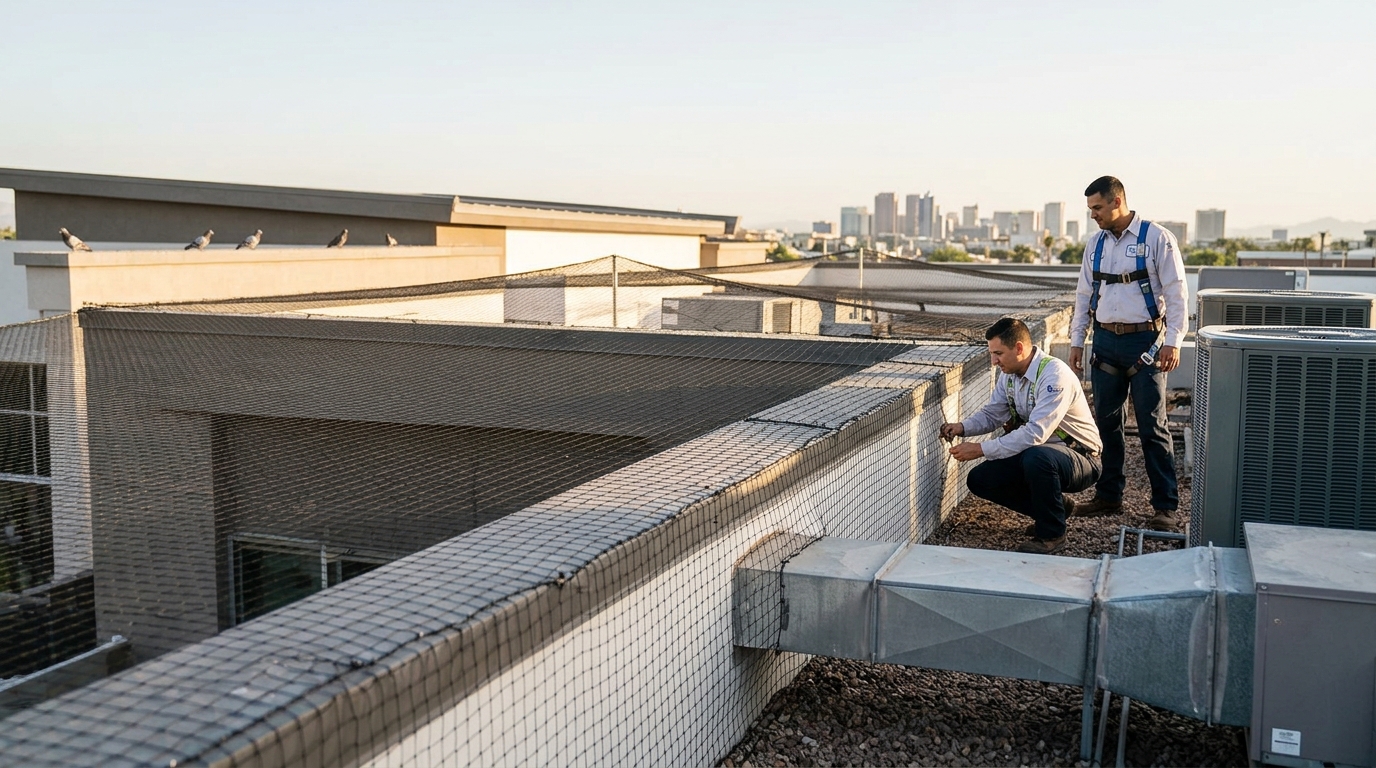
For commercial roofs, bird netting is generally more effective than spike strips for preventing pigeon infestations. Netting creates a continuous physical barrier that blocks access to entire roof surfaces, whereas spikes only deter birds from specific perching lines. This guide compares the effectiveness, limitations, and hybrid applications of both methods for commercial properties in the Greater Phoenix area.
Bird Netting Effectiveness
Bird netting is a comprehensive exclusion method that physically prevents birds from accessing roof surfaces, ledges, and structural gaps. It is particularly effective for commercial buildings with large, flat, or low-slope roofs where pigeons can easily land and nest. The primary advantage of netting is its ability to cover extensive areas, creating a seamless barrier that denies birds access to the entire protected zone.
Continuous Barrier Coverage
Unlike point-based deterrents, netting provides continuous coverage. This is critical for commercial properties where pigeons may move across the roof to find shelter or nesting sites. By blocking access to the roof surface, netting prevents the accumulation of droppings, nesting materials, and the associated health risks. It is also effective in preventing birds from entering gaps between roof membranes and parapet walls.
Long-Term Durability and Maintenance
High-quality bird netting is designed to withstand harsh weather conditions, including intense sun and wind. When installed correctly, it can last for many years with minimal maintenance. This makes it a cost-effective long-term solution for commercial property managers who want to avoid recurring pest control expenses. The durability of the netting ensures that the exclusion remains effective over time, providing consistent protection for the building.
Integration with Solar Panels
For commercial buildings with solar panel installations, netting is often the preferred method. It can be installed over or around solar arrays to prevent pigeons from nesting under the panels, which can cause damage and reduce energy efficiency. Solar panel cleaning and protection services often include netting to ensure that the panels remain unobstructed and functional. This integration is crucial for maintaining the performance and longevity of solar investments.
Spike Strip Limitations
Spike strips are a common bird deterrent used to prevent perching on narrow ledges, gutters, and railings. While they are effective for specific applications, they have significant limitations when used as a primary exclusion method for commercial roofs. Understanding these limitations is essential for selecting the right bird control strategy.
Point-Based Deterrence
Spike strips only deter birds from the specific areas where they are installed. They do not prevent birds from landing on other parts of the roof or entering through gaps and openings. For commercial buildings with large roof areas, installing spikes on every possible perching surface is often impractical and costly. This point-based approach leaves many areas of the roof vulnerable to pigeon activity.
Weather and Wear Considerations
Spike strips are subject to wear and tear from weather exposure. Over time, the spikes can become loose, bent, or damaged, reducing their effectiveness. Regular inspection and maintenance are required to ensure that the spikes remain in good condition. This ongoing maintenance can be a burden for commercial property managers, especially for large buildings with extensive ledge areas.
Aesthetic and Structural Constraints
Spike strips can be visually intrusive, particularly on prominent architectural features. They may not be suitable for all building designs, and their installation can sometimes interfere with structural elements or drainage systems. Additionally, spikes do not address the root cause of pigeon infestations, which is often the availability of shelter and nesting sites. They are a deterrent, not an exclusion, and may only delay rather than prevent bird activity.
Hybrid Combination Approaches
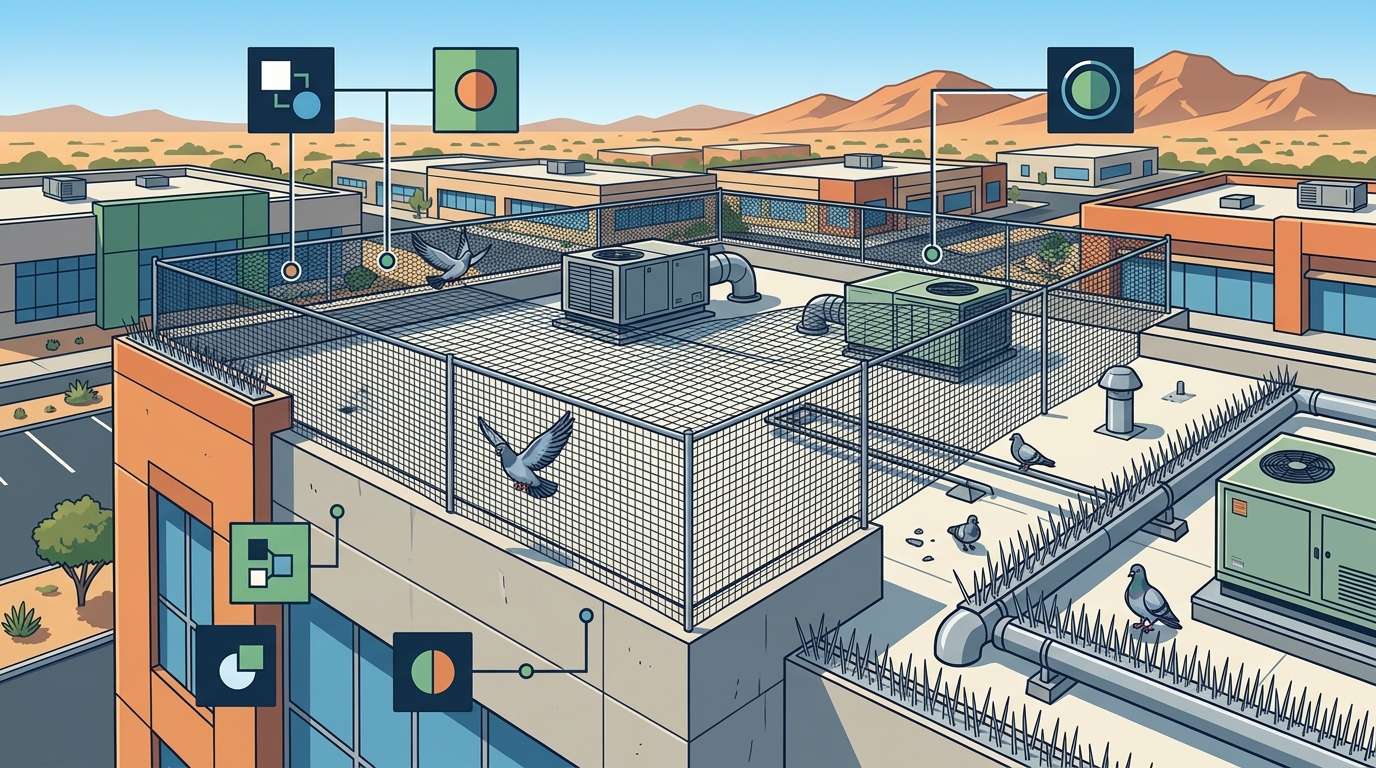
For many commercial properties, the most effective bird control strategy is a hybrid approach that combines bird netting with spike strips and other deterrents. This method leverages the strengths of each technique to provide comprehensive protection. By using netting for large roof areas and spikes for specific perching points, property managers can create a multi-layered defense against pigeon infestations.
Strategic Placement of Deterrents
A hybrid approach allows for strategic placement of deterrents based on the specific needs of the building. Netting can be used to cover flat roof sections and solar panel arrays, while spike strips can be installed on narrow ledges, gutters, and railings. This targeted approach ensures that all potential access points are addressed, providing a more robust exclusion than either method alone.
Cost-Effectiveness and Flexibility
Combining netting and spikes can be more cost-effective than using either method exclusively. By using netting for large areas and spikes for smaller, specific points, property managers can optimize their investment. This flexibility allows for customization based on the building's architecture and the observed behavior of local pigeon populations. A professional assessment can help determine the optimal combination of deterrents for each property.
Professional Installation and Assessment
Implementing a hybrid bird control strategy requires professional expertise. A thorough assessment of the building is necessary to identify all potential entry points and perching areas. Free estimates and on-site inspections can help property managers develop a customized plan that addresses their specific needs. Professional installation ensures that both netting and spikes are installed correctly, maximizing their effectiveness and longevity.
| Feature | Bird Netting | Spike Strips |
|---|---|---|
| Coverage Area | Large, continuous areas | Narrow, specific lines |
| Primary Function | Exclusion (blocks access) | Deterrence (discourages perching) |
| Best For | Flat roofs, solar panels, large ledges | Gutters, railings, narrow ledges |
| Maintenance | Low (durable material) | Medium (requires inspection) |
| Effectiveness for Commercial Roofs | High (comprehensive barrier) | Moderate (point-based only) |
Key Takeaways
- Bird netting is more effective for commercial roofs because it provides a continuous physical barrier that blocks access to large areas.
- Spike strips are limited to point-based deterrence and do not prevent birds from accessing other parts of the roof.
- A hybrid approach combining netting and spikes offers the most comprehensive protection for commercial properties.
- Netting is particularly important for protecting solar panels from pigeon nesting and damage.
- Professional assessment is crucial for determining the optimal bird control strategy for each building.
- High-quality netting is durable and requires minimal maintenance, making it a cost-effective long-term solution.
- Spike strips require regular inspection and maintenance to ensure they remain effective.
- Combining exclusion methods with deterrents creates a multi-layered defense against pigeon infestations.
Frequently Asked Questions
Is bird netting better than spikes for commercial roofs?
Yes, bird netting is generally better for commercial roofs because it provides a continuous barrier that blocks access to large areas. Spikes only deter birds from specific perching lines and do not prevent them from landing elsewhere on the roof.
Can I use both netting and spikes on my building?
Yes, a hybrid approach that combines netting and spikes is often the most effective strategy. Netting can be used for large roof areas, while spikes can be installed on narrow ledges and gutters for additional deterrence.
How long does bird netting last?
High-quality bird netting can last for many years, depending on the material and weather conditions. It is designed to withstand intense sun and wind, requiring minimal maintenance over its lifespan.
Do spike strips need maintenance?
Yes, spike strips require regular inspection to ensure that the spikes remain secure and undamaged. Weather exposure can cause wear and tear, reducing their effectiveness over time.
Is netting effective for solar panels?
Yes, netting is highly effective for protecting solar panels from pigeon nesting. It prevents birds from accessing the area under the panels, which can cause damage and reduce energy efficiency.
How do I choose the right bird control method for my building?
A professional assessment is the best way to choose the right method. An expert can evaluate your building's architecture and identify the optimal combination of netting, spikes, and other deterrents for your specific needs.
Are there any downsides to using bird netting?
The main downside of bird netting is the initial installation cost, which can be higher than spikes for small areas. However, for large commercial roofs, netting is often more cost-effective in the long run due to its durability and comprehensive coverage.
Can pigeons still get under netting?
If installed correctly, bird netting creates a seamless barrier that prevents pigeons from getting underneath. Professional installation ensures that all gaps and openings are sealed, providing complete exclusion.
Conclusion
For commercial roofs, bird netting is the more effective solution compared to spike strips due to its ability to provide a continuous physical barrier. While spike strips are useful for specific perching points, they do not offer the comprehensive protection that netting provides. A hybrid approach that combines both methods can offer the best of both worlds, ensuring that all potential access points are addressed. Professional Pigeon Control offers expert assessments and customized bird control solutions for commercial properties in the Greater Phoenix area. Contact us today to schedule a free on-site assessment and develop a long-term pigeon prevention plan for your building.