
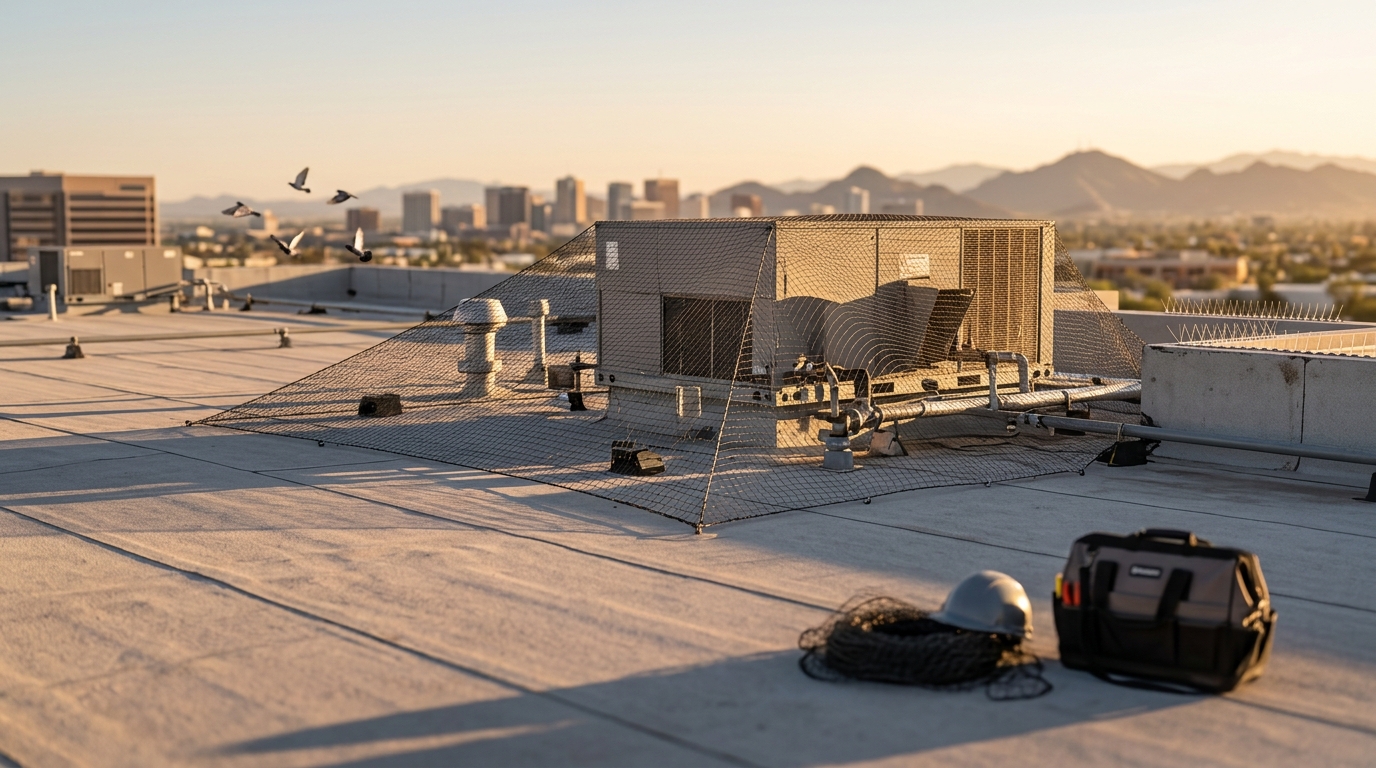
For most commercial roofs, bird netting is more effective than spike strips because it covers large, flat surfaces and prevents pigeons from landing anywhere on the roof. Spike strips only work on narrow ledges and gutters. This guide compares the two methods, explains their limitations, and helps you choose the right solution for your property. according to Has the CTDOT
Bird Netting Effectiveness
Bird netting is a physical barrier system that covers open roof areas to prevent birds from landing or nesting. It is the preferred solution for large commercial buildings with flat or low-slope roofs. Unlike other deterrents, netting addresses the entire surface area rather than just specific perching spots.
Coverage and Structural Integrity
Commercial roofs often span thousands of square feet. Spike strips cannot cover this much area efficiently. Netting, however, can be stretched across the entire roof or specific zones where pigeons congregate. This comprehensive coverage ensures that no flat surface remains accessible to birds. The material used in professional netting is typically UV-stabilized polyethylene, which withstands Arizona's intense sun and heat without degrading quickly.
Prevention of Nesting and Droppings
Pigeons prefer flat, unobstructed surfaces for nesting. By covering these areas with netting, you eliminate their primary habitat. This prevents the accumulation of droppings, which can cause significant damage to roofing materials and create health hazards. Netting also blocks access to HVAC units and skylights, protecting these critical components from bird debris and blockages.
Long-Term Durability
When installed correctly, bird netting provides a long-term solution. It does not rely on psychological deterrents that birds may eventually ignore. Instead, it creates a physical impossibility for landing. Professional Pigeon Control offers a five-year warranty on qualifying exclusion services, reflecting the durability and reliability of properly installed netting systems.
Spike Strip Limitations
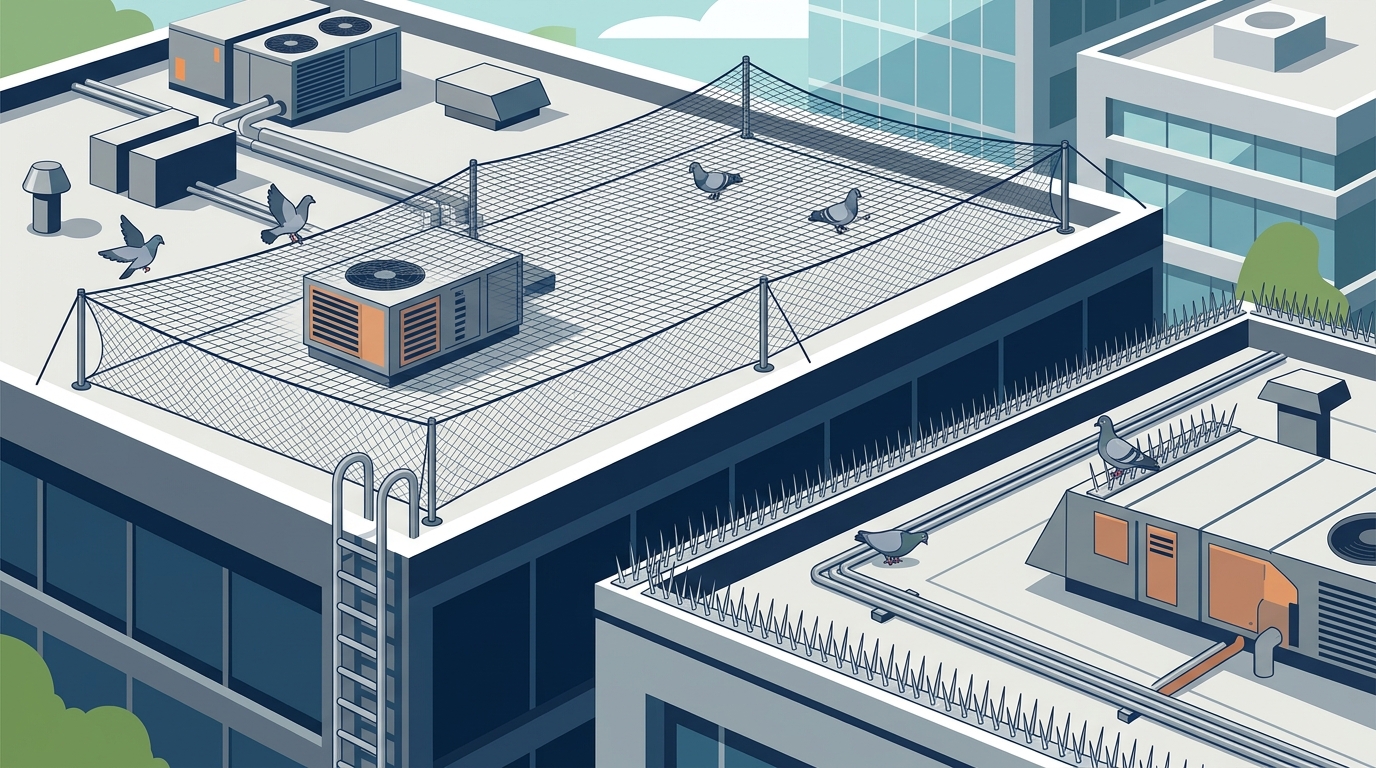
Spike strips are rows of metal or plastic spikes installed on ledges, gutters, and window sills to prevent birds from perching. While useful in specific scenarios, they have significant limitations for commercial roof applications.
Surface Area Constraints
Behavioral Adaptation
Spike strips rely on discomfort to deter birds. Over time, some bird species may adapt to the presence of spikes or find alternative perching spots nearby. This behavioral adaptation reduces the long-term effectiveness of spike strips. In contrast, physical barriers like netting do not require birds to change their behavior; they simply cannot access the area.
Aesthetic and Maintenance Considerations
Spike strips can be visually intrusive, especially when installed in large quantities. They may also require regular maintenance to ensure they remain secure and effective. Wind, debris, and physical impact can dislodge or damage spikes, necessitating frequent inspections and repairs. Netting, while visible, is often less obtrusive and requires less frequent maintenance when installed by professionals.
Key Takeaways
- Bird netting is more effective for large commercial roofs because it covers entire surfaces.
- Spike strips are limited to narrow ledges and gutters, making them unsuitable for flat roofs.
- Netting prevents nesting and droppings by creating a physical barrier.
- Spike strips rely on discomfort, which birds may eventually adapt to.
- Professional installation is critical for both netting and spike strips to ensure effectiveness.
- Netting offers a longer-term solution with less maintenance than spike strips.
- Professional Pigeon Control provides a five-year warranty on qualifying exclusion services.
Frequently Asked Questions
Is bird netting better than spike strips for commercial roofs?
Yes, for large flat roofs, bird netting is generally more effective because it covers the entire surface area. Spike strips are only useful for narrow ledges and gutters.
How long does bird netting last?
Professional-grade bird netting can last several years, depending on the material and environmental conditions. Professional Pigeon Control offers a five-year warranty on qualifying exclusion services.
Can spike strips be used on a flat roof?
No, spike strips are not practical for flat roofs. They are designed for narrow, linear surfaces like ledges and gutters.
Do pigeons adapt to spike strips?
Yes, some birds may adapt to the discomfort of spike strips over time, reducing their effectiveness. Physical barriers like netting are more reliable in the long term.
What is the best way to prevent pigeons on a commercial roof?
The best way is to use a combination of physical barriers, such as bird netting, and exclusion techniques to seal entry points. Professional assessment is recommended to determine the best approach for your specific property.
Does Professional Pigeon Control offer solar panel cleaning?
Yes, Professional Pigeon Control offers professional solar panel cleaning to remove pigeon debris and dirt buildup that can affect the appearance and performance of your solar system.
Conclusion
Choosing between bird netting and spike strips for commercial roofs depends on the specific layout and size of your property. For large, flat roofs, bird netting is the superior choice due to its comprehensive coverage and long-term durability. Spike strips are best reserved for narrow ledges and gutters. Professional Pigeon Control offers expert assessment and installation services, backed by a five-year warranty, to ensure your property remains pigeon-free. To schedule a free estimate, . according to Screens and Other