

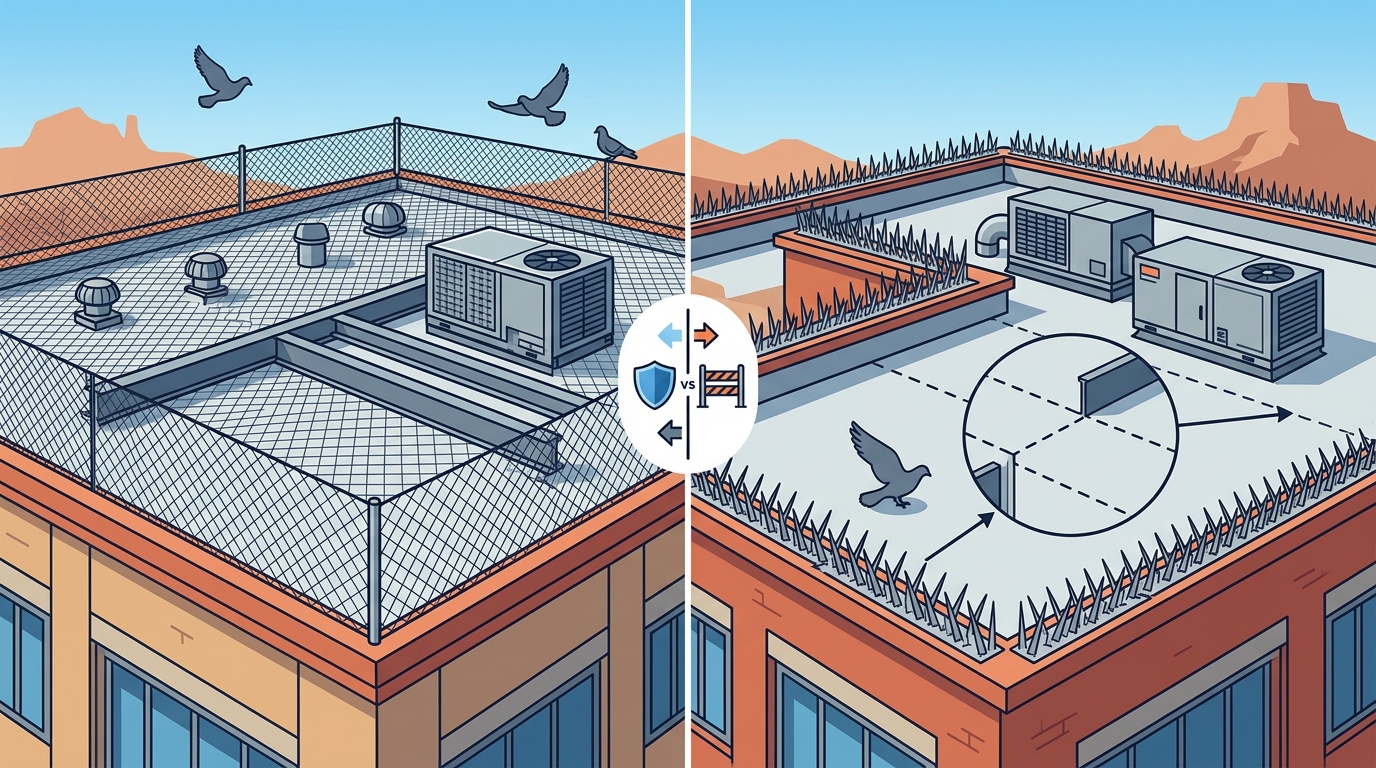
For most commercial roofs, bird netting is more effective than spike strips because it creates a continuous physical barrier that prevents pigeons from accessing the entire surface. Spike strips only deter birds from specific perching lines, leaving large open areas vulnerable to nesting and roosting. This guide compares the effectiveness, limitations, and hybrid applications of both methods for commercial properties in the Greater Phoenix area.
Bird Netting Effectiveness
Bird netting is a comprehensive exclusion method that covers large roof areas to prevent bird access entirely. It is the preferred solution for commercial buildings with flat or low-slope roofs where pigeons can easily walk and nest. Unlike point-based deterrents, netting addresses the root cause of infestation by eliminating the space birds need to establish colonies.
Continuous Barrier Coverage
Netting provides a continuous physical barrier that blocks pigeons from landing, nesting, or roosting on the covered surface. This is critical for commercial properties where even small gaps can allow birds to enter and establish a presence. The netting is typically installed over the entire roof or over specific vulnerable zones such as HVAC units, skylights, and parapet walls.
Protection Against Nesting and Droppings
By preventing birds from accessing the roof, netting stops the accumulation of droppings, nesting materials, and the associated health risks. Pigeon droppings can carry pathogens such as histoplasmosis and cryptococcosis, which pose serious health hazards to building occupants. Netting also protects roof membranes from damage caused by bird activity and droppings, extending the lifespan of the roofing system.
Long-Term Durability and Maintenance
Professional-grade bird netting is designed to withstand harsh weather conditions, including intense sun, wind, and rain. When installed correctly, it can last for many years with minimal maintenance. Regular inspections are recommended to check for wear, tear, or damage, but the overall maintenance burden is low compared to other methods. At Professional Pigeon Control, we use high-quality netting materials that are UV-resistant and durable, ensuring long-term protection for commercial properties.
Spike Strip Limitations
Spike strips are a common bird deterrent used to prevent birds from perching on ledges, gutters, and other narrow surfaces. While effective for specific applications, they have significant limitations when used as a primary solution for commercial roofs.
Point-Based Deterrence Only
Spike strips only deter birds from the specific lines where they are installed. They do not prevent birds from accessing the rest of the roof surface. Pigeons can easily walk around spike strips and nest in open areas, making them an incomplete solution for large commercial roofs. This limitation means that spike strips must be installed extensively to be effective, which can be costly and visually intrusive.
Visual and Aesthetic Concerns
Spike strips can be visually unappealing, especially when installed in large quantities on commercial buildings. They may detract from the building's appearance and create a cluttered look. For properties where aesthetics are a priority, such as office buildings or retail centers, spike strips may not be the best choice. Netting, on the other hand, can be installed in a way that is less visible and more aesthetically pleasing.
Effectiveness Varies by Bird Species
The effectiveness of spike strips can vary depending on the bird species. Some birds, such as pigeons, may be deterred by spikes, while others, such as starlings or sparrows, may be less affected. Additionally, birds can become habituated to spike strips over time, reducing their effectiveness. This variability makes spike strips a less reliable solution for long-term bird control on commercial properties.
Hybrid Combination Approaches
For many commercial properties, a hybrid approach that combines bird netting with spike strips offers the best of both worlds. This strategy leverages the comprehensive coverage of netting and the targeted deterrence of spike strips to create a robust bird control system.
Strategic Placement of Spike Strips
In a hybrid approach, spike strips are strategically placed on specific ledges, gutters, and other narrow surfaces where birds are most likely to perch. This complements the netting, which covers the main roof surface. By combining both methods, property owners can ensure that birds are deterred from all potential access points and perching areas.
Enhanced Protection and Aesthetics
A hybrid approach can enhance the overall protection of the building while maintaining a more aesthetically pleasing appearance. The netting provides the primary barrier, while the spike strips add an extra layer of deterrence in key areas. This combination can be tailored to the specific needs of the property, ensuring that the bird control system is both effective and visually acceptable.
Cost-Effectiveness and Long-Term Value
While a hybrid approach may have a higher initial cost than using either method alone, it can provide better long-term value. By preventing birds from accessing the roof entirely, a hybrid system reduces the need for frequent cleanups and repairs, saving money over time. At Professional Pigeon Control, we design custom hybrid solutions that balance cost, effectiveness, and aesthetics to meet the unique needs of each commercial property.
Comparison of Bird Netting and Spike Strips
| Feature | Bird Netting | Spike Strips |
|---|---|---|
| Coverage Area | Large, continuous areas | Narrow, specific lines |
| Prevents Nesting | Yes | No |
| Visual Impact | Low to moderate | High |
| Maintenance | Low | Moderate |
| Best For | Flat or low-slope roofs | Ledges, gutters, and narrow surfaces |
Key Takeaways
- Bird netting is more effective than spike strips for commercial roofs because it provides continuous coverage and prevents nesting.
- Spike strips are limited to point-based deterrence and do not prevent birds from accessing open roof areas.
- A hybrid approach combining netting and spike strips offers the best protection for many commercial properties.
- Netting protects roof membranes from damage and reduces the need for frequent cleanups.
- Spike strips can be visually intrusive and may lose effectiveness over time as birds become habituated.
- Professional installation is critical for both netting and spike strips to ensure long-term effectiveness.
- Regular inspections and maintenance are necessary to keep bird control systems in optimal condition.
- Choosing the right bird control method depends on the specific layout and needs of the commercial property.
Frequently Asked Questions
Is bird netting better than spike strips for commercial roofs?
Yes, bird netting is generally better for commercial roofs because it provides continuous coverage and prevents birds from nesting. Spike strips only deter birds from specific lines and do not prevent access to open roof areas.
Can spike strips be used in combination with bird netting?
Yes, a hybrid approach that combines bird netting with spike strips can provide enhanced protection. Spike strips can be strategically placed on ledges and gutters to complement the netting.
How long does bird netting last on a commercial roof?
Professional-grade bird netting can last for many years, depending on the quality of the material and the local weather conditions. Regular inspections are recommended to check for wear and tear.
Are spike strips effective against all bird species?
No, the effectiveness of spike strips can vary by bird species. Some birds may be deterred by spikes, while others may become habituated over time.
What is the best way to prevent pigeons from nesting on a commercial roof?
The best way to prevent pigeons from nesting is to use a comprehensive exclusion method such as bird netting. This creates a physical barrier that prevents birds from accessing the roof surface.
How often should bird control systems be inspected?
Bird control systems should be inspected at least once a year to check for wear, tear, or damage. More frequent inspections may be necessary in areas with high bird activity or harsh weather conditions.
Can bird netting be installed on any type of commercial roof?
Bird netting can be installed on most types of commercial roofs, including flat, low-slope, and pitched roofs. The specific installation method may vary depending on the roof type and layout.
What are the health risks associated with pigeon droppings on commercial roofs?
Pigeon droppings can carry pathogens such as histoplasmosis and cryptococcosis, which pose serious health hazards to building occupants. Regular cleanup and prevention are essential to mitigate these risks.
Conclusion
For commercial roofs, bird netting is the more effective solution compared to spike strips due to its ability to provide continuous coverage and prevent nesting. While spike strips can be useful as a supplementary deterrent, they are not sufficient as a primary solution for large commercial properties. A hybrid approach that combines both methods can offer the best protection, balancing effectiveness, aesthetics, and cost. At Professional Pigeon Control, we provide expert consultation and installation services to help you choose the right bird control solution for your commercial property. Contact us today for a free assessment and customized plan.