
The Mechanics of Pigeon Perching
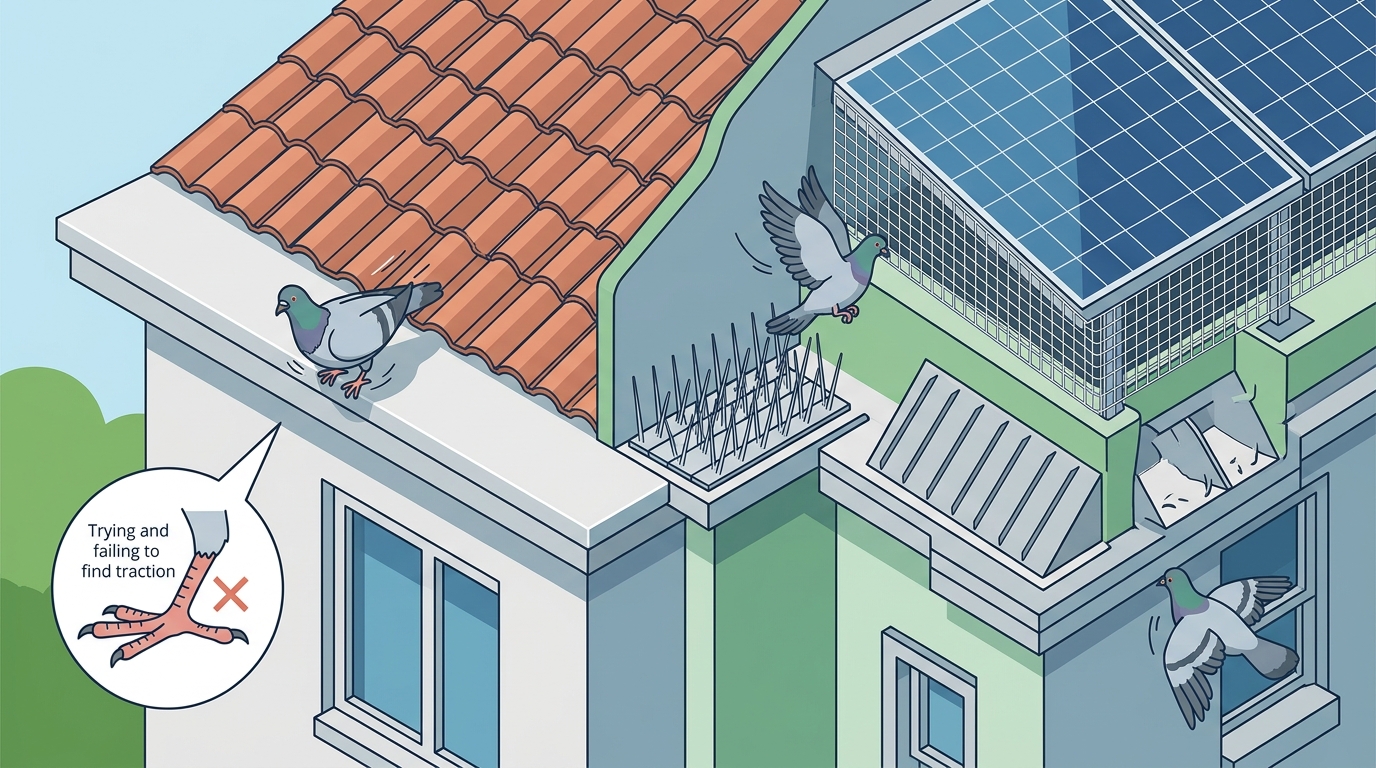
Pigeons are not like other birds that can perch on any flat surface. Their anatomy requires a specific type of grip to maintain balance. A pigeon's feet are designed to grasp and hold onto narrow edges, ledges, or wires. If a surface is too wide, too smooth, or covered with a physical barrier, the bird cannot achieve the necessary grip to land safely. This biological limitation is the foundation of all effective exclusion methods.
When a pigeon attempts to land on a surface equipped with bird spikes, the sharp points prevent the feet from making contact with the underlying material. The bird perceives the surface as unstable and immediately flies away. This reaction is instinctual and consistent. Unlike chemical repellents, which pigeons can habituate to over time, physical barriers remain effective indefinitely because they do not rely on a sensory trigger that can be ignored.
Professional Pigeon Control utilizes this understanding of avian anatomy to design custom exclusion plans. By identifying the exact points where pigeons are landing, technicians can install barriers that render those specific spots unusable. This precision ensures that the birds are denied access to the property without causing them harm.
Netting and Mesh as Exclusion Tools
Netting is one of the most versatile physical barriers used in pigeon control. It is a durable, UV-resistant mesh that is installed over open spaces such as eaves, soffits, and the gaps between solar panels and roofs. The netting creates a physical wall that pigeons cannot fly through. This is particularly effective for preventing birds from entering attics or nesting under structures where they are difficult to see and remove.
The effectiveness of netting depends on its installation. The mesh must be taut and securely anchored to prevent sagging, which could create gaps large enough for a pigeon to squeeze through. Professional installation ensures that the netting is invisible from the ground while providing a complete barrier. This method is often used in conjunction with other exclusion techniques to create a multi-layered defense system.
For properties with solar panels, netting is a critical component of protection. Pigeons often nest in the shaded area beneath the panels, where their droppings can cause significant damage and reduce energy efficiency. By installing netting over the panel array, you prevent access to this nesting site. This not only protects the birds from harm but also preserves the performance and longevity of your solar investment.
Wire Systems and Spike Installation
Bird wire is a thin, flexible cable that is installed across ledges, gutters, and window sills. It is designed to be nearly invisible but creates a physical barrier that prevents pigeons from landing. The wire is typically installed in a way that allows for easy maintenance and cleaning. It is a cost-effective solution for long, narrow surfaces where spikes might be less practical.
Bird spikes, on the other hand, are rigid plastic or metal points that are attached to surfaces. They are ideal for flat ledges and roof edges. The spikes are spaced closely enough to prevent a pigeon from finding a gap to land in. Both wire and spikes are humane methods that do not harm the birds; they simply make the property an unsuitable location for roosting.
Choosing between wire and spikes depends on the specific architecture of the property. A professional assessment can determine which method will be most effective and aesthetically pleasing. The goal is to create a seamless integration of the barrier with the building's design, ensuring that the exclusion is both functional and unobtrusive.
Why Temporary Deterrents Fail
Many property owners try to solve pigeon problems with temporary deterrents such as visual scares or sound devices. These methods often provide short-term relief but fail in the long run. Pigeons are adaptable and will quickly learn that a flashing light or a recorded predator sound is not a real threat. Once they realize the deterrent is harmless, they will return to the property.
Physical barriers, however, cannot be habituated to. A pigeon cannot learn to ignore a spike or a net. The barrier remains a physical obstacle regardless of the bird's experience. This is why exclusion is considered the gold standard in pigeon control. It provides a permanent solution that does not require ongoing maintenance or replacement of deterrent devices.
Professional Pigeon Control emphasizes the importance of a comprehensive approach. Removing existing pigeons is only the first step. Without exclusion, new birds will simply move in to take the place of the removed ones. By combining removal with physical barriers, you ensure that the property remains pigeon-free in the long term.
Key Takeaways
- Physical barriers work by exploiting the anatomical limitations of pigeons, preventing them from perching or nesting.
- Netting is highly effective for blocking access to attics, eaves, and solar panel gaps.
- Bird spikes and wire systems are ideal for ledges, gutters, and window sills.
- Temporary deterrents like sound or visual scares are ineffective in the long term because pigeons habituate to them.
- Professional installation is crucial to ensure that barriers are secure, durable, and aesthetically integrated.
- Exclusion is the only method that provides a permanent solution to pigeon infestations.
Frequently Asked Questions
Do physical barriers harm pigeons?
No, physical barriers are designed to be humane. They prevent pigeons from landing or nesting but do not cause injury. The birds simply fly away to find a different location.
How long do physical barriers last?
High-quality barriers such as UV-resistant netting and stainless steel spikes can last for many years. They are designed to withstand weather conditions and require minimal maintenance.
Can I install physical barriers myself?
While some simple installations may be possible for DIY enthusiasts, professional installation is recommended. Professionals ensure that the barriers are secure, effective, and properly integrated with the property's architecture.
Will physical barriers affect the appearance of my property?
When installed correctly, physical barriers are often nearly invisible. Netting can be chosen to match the color of the building, and spikes are small and unobtrusive. A professional can help minimize any visual impact. according to Identifying important factors
Are physical barriers effective for all types of buildings?
Yes, physical barriers can be adapted to a wide range of building types, from residential homes to large commercial structures. The specific method used will depend on the architecture and the areas where pigeons are present.