
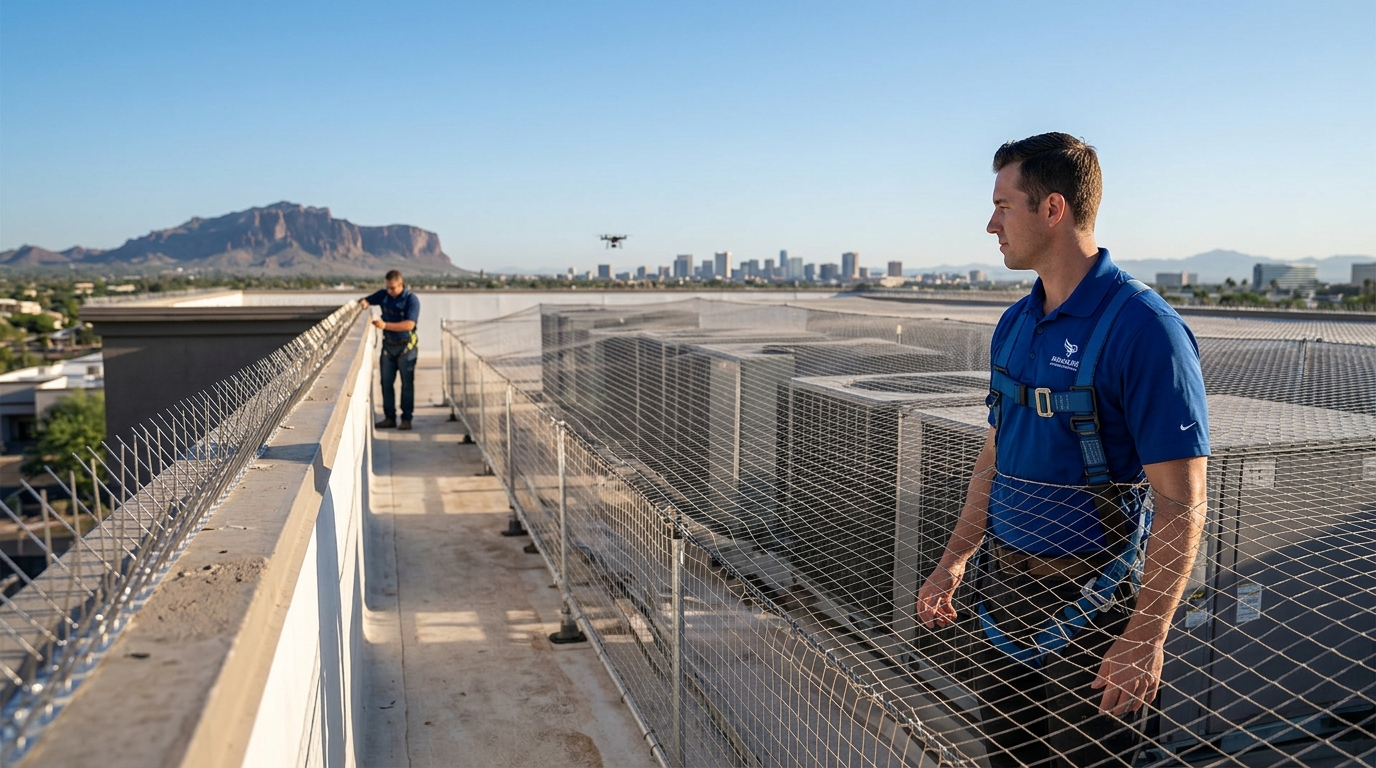
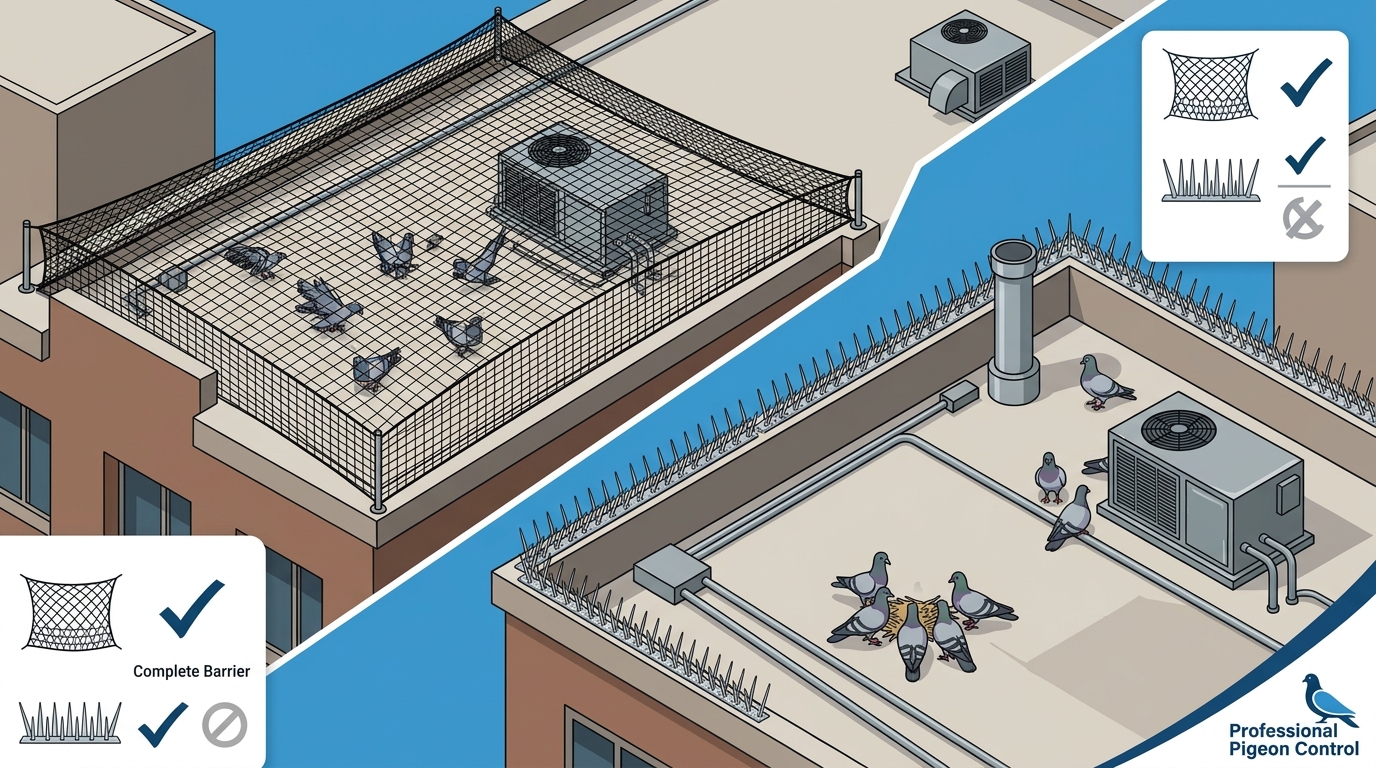
For commercial roofs, bird netting is generally more effective than spike strips because it creates a continuous physical barrier that prevents pigeons from accessing the entire roof surface. Spike strips only deter birds from specific perching lines, leaving large open areas vulnerable to nesting and roosting. This guide compares the effectiveness, limitations, and hybrid applications of both methods for commercial properties in the Greater Phoenix area.
Bird Netting Effectiveness
Bird netting is a comprehensive exclusion method that covers large roof areas to prevent bird access entirely. For commercial buildings, this full-coverage approach is critical because pigeons often roost in large flocks and require extensive space. Netting works by creating a physical barrier that birds cannot penetrate, effectively sealing off the roof surface from nesting and perching.
Full-Coverage Protection
Unlike point-based deterrents, netting provides uniform protection across the entire treated area. This is particularly important for commercial roofs with flat or low-slope designs, where pigeons can easily access multiple entry points. The netting material is typically made from durable, UV-resistant polyethylene that withstands Arizona's intense sun and heat.
Long-Term Durability
Professional-grade bird netting is designed to last for many years with proper installation. The material resists degradation from UV exposure and weathering, making it a cost-effective long-term solution. When installed correctly, netting requires minimal maintenance and continues to provide reliable protection against pigeon infestations.
Commercial Application Benefits
Spike Strip Limitations
Spike strips are a common bird deterrent that works by making specific surfaces uncomfortable for perching. While effective in certain applications, spike strips have significant limitations when used as a primary control method for commercial roofs. Understanding these limitations is essential for selecting the right pigeon control strategy.
Point-Based Deterrence Only
Spike strips only deter birds from the specific lines where they are installed. Pigeons can easily bypass spike strips by moving to adjacent areas of the roof that remain unprotected. This point-based approach leaves large portions of the roof surface vulnerable to roosting and nesting, which is a critical weakness for commercial properties.
Behavioral Adaptation
Pigeons are intelligent birds that can adapt to environmental changes over time. Some flocks may learn to tolerate spike strips or find ways to work around them. This behavioral adaptation reduces the long-term effectiveness of spike-only solutions, particularly in areas with persistent pigeon populations.
Maintenance and Aesthetic Concerns
Spike strips require regular inspection and maintenance to ensure they remain effective. Individual spikes can become damaged or dislodged, creating gaps in the deterrent line. Additionally, spike strips can be visually intrusive on commercial buildings, potentially affecting the professional appearance of the property.
Hybrid Combination Approaches
The most effective pigeon control strategy for commercial roofs often combines bird netting with spike strips in a hybrid approach. This combination leverages the strengths of both methods while mitigating their individual limitations. Professional Pigeon Control recommends hybrid solutions for many commercial properties in the Greater Phoenix area.
Strategic Placement
In a hybrid approach, bird netting provides full-coverage protection for the main roof surface, while spike strips are installed at specific vulnerable points such as ledges, HVAC units, and skylight frames. This targeted combination ensures comprehensive protection without unnecessary material costs.
Enhanced Deterrence
Combining netting with spikes creates a multi-layered deterrent system. The netting prevents access to the roof surface, while the spikes provide additional deterrence at entry points and perching areas. This dual approach makes it extremely difficult for pigeons to establish roosting sites on the property.
Cost-Effectiveness
Hybrid solutions can be more cost-effective than using either method alone. By using netting for large areas and spikes for targeted points, property owners can optimize their investment while achieving superior protection. This approach also allows for easier maintenance, as different components can be serviced independently.
Netting vs. Spikes Comparison
| Feature | Bird Netting | Spike Strips |
|---|---|---|
| Coverage Area | Full roof surface | Specific perching lines only |
| Effectiveness for Large Flocks | High | Moderate to Low |
| Long-Term Durability | High (UV-resistant material) | Moderate (requires maintenance) |
| Installation Complexity | Higher (professional installation required) | Lower (simpler installation) |
| Aesthetic Impact | Minimal (discreet appearance) | Moderate (visible spikes) |
| Best Application | Commercial roofs, large flat areas | Ledges, HVAC units, specific perching points |
| Maintenance Requirements | Low (periodic inspection) | Moderate (regular inspection and repair) |
Key Takeaways
- Bird netting provides full-coverage protection for commercial roofs, making it more effective than spike strips for large areas.
- Spike strips only deter birds from specific perching lines, leaving adjacent roof areas vulnerable to infestation.
- Hybrid approaches combining netting and spikes offer the most comprehensive protection for commercial properties.
- Professional installation is critical for both methods to ensure long-term effectiveness and safety.
- Bird netting is particularly well-suited for flat or low-slope commercial roofs common in the Phoenix area.
- Spike strips work best as a supplementary deterrent at specific vulnerable points like HVAC units and ledges.
- Regular inspection and maintenance are essential for maintaining the effectiveness of any pigeon control system.
- Choosing the right method depends on your specific roof layout, pigeon population, and property requirements.
Frequently Asked Questions
Is bird netting better than spike strips for commercial roofs?
Yes, bird netting is generally more effective for commercial roofs because it provides full-coverage protection. Spike strips only deter birds from specific lines, leaving large areas of the roof vulnerable to roosting and nesting.
Can I use spike strips alone for pigeon control on a commercial building?
Spike strips alone are not recommended as a primary control method for commercial roofs. They should be used as a supplementary deterrent in combination with other methods like netting for comprehensive protection.
How long does bird netting last on a commercial roof?
Professional-grade bird netting is designed to last for many years with proper installation and minimal maintenance. The UV-resistant material withstands Arizona's climate, providing long-term protection against pigeon infestations.
What is the best hybrid approach for commercial pigeon control?
The best hybrid approach combines bird netting for full roof coverage with spike strips at specific vulnerable points like HVAC units, ledges, and skylight frames. This multi-layered system provides comprehensive protection.
Do spike strips work on flat commercial roofs?
Spike strips have limited effectiveness on flat commercial roofs because they only deter birds from specific lines. Pigeons can easily bypass the spikes by moving to adjacent unprotected areas of the roof.
How often should I inspect my pigeon control system?
We recommend inspecting your pigeon control system at least twice a year, or more frequently if you notice increased bird activity. Regular inspections help identify any damage or gaps in the system that need repair.
Can pigeons learn to bypass spike strips?
Yes, pigeons are intelligent birds that can adapt to environmental changes over time. Some flocks may learn to tolerate spike strips or find ways to work around them, reducing their long-term effectiveness.
Is professional installation necessary for bird netting?
Yes, professional installation is essential for bird netting to ensure proper coverage, safety, and long-term effectiveness. Professional installers have the expertise to assess your specific roof layout and implement the most effective solution.
Conclusion
For commercial roofs, bird netting is the more effective primary control method due to its full-coverage protection. Spike strips serve as a valuable supplementary deterrent but are insufficient as a standalone solution for large commercial properties. The most effective strategy often combines both methods in a hybrid approach, tailored to your specific roof layout and pigeon population. Professional Pigeon Control offers expert assessment and installation of both netting and spike systems for commercial properties throughout the Greater Phoenix area. To discuss your specific pigeon control needs, for a free consultation.